I’ve been busy. My life has just entered a new stage, and I am slowly adjusting. Faced with new realities, confronted with plausibly unexciting prospects, I find myself pondering often about life choices. This is not necessarily a bad thing, though it makes one weary at times, especially when there aren’t that many exciting choices at one’s disposal. I only hope that things will improve, that I will settle into the present state soon enough and enjoy doing the stuff I enjoy, like writing for leisure. I also miss the long, idle hours spent reading books and doing sports like swimming – and the occasion run. These days, I am just too tired to do anything.
Tuesday, October 17, 2006

Monday, October 16, 2006
Re: MM Lee's remarks and his reply to Malaysian PM
This follows from my previous post on the issue.
MM Lee's reply to Malaysian PM Abdullah was published in the ST on 3 October. There are a few insights to be gleaned from the contents of his letter and its impressive annex.
MM Lee's reply to Malaysian PM Abdullah was published in the ST on 3 October. There are a few insights to be gleaned from the contents of his letter and its impressive annex.
It was obvious right from the start that MM Lee's remarks would not be to the liking of Singapore's neighbours. Yet, I believe, it was never MM Lee's intention to criticise them. (I am not saying this in defence of him; indeed i believe Singapore, in terms of its bilateral relations with its neighbours, would do better without those remarks from the MM.) He was being merely characteristically blunt and candid, and by pointing out (in his letter to Malaysian PM Abdullah Badawi) that he made those remarks in a "free-flowing dialogue", it was meant to convey the message that they were not made as criticism.
One may recall that MM Lee made those controversial remarks at a diaglogue on good governance. Though the ensuing controversy was in the main about race relations in Singapore's neighbouring states, relevant to the context in which he made those remarks, he made an important point on the kind of government Singapore needed owing to its geo-ethno environment: it was a government that was "really firm, stout-hearted, subtle and resolute". However, this message was ultimately drowned by the reasoning MM Lee provided to prove his point. In a somewhat ironic twist, the ensuing furore in Malaysia created a situation that seemed apt for MM Lee to demonstrate the essence of his remarks. His published reply to Malaysian PM Abdullah Badawi - made in a personal capacity, not government - seemed to bear out his advice.
At the dialogue session before a foreign audience who were in Singapore attending the IMF/World Bank meetings, MM Lee made reference to racial relations in neighbouring states to explain why Singapore needed a "firm, stout-hearted, subtle and resolute" government; such a government is needed in order to manage the Republic's relations with its neighbours. His view is that the attitude of Malaysia and Indonesia towards the Republic is shaped by their treatment of their minority Chinese. He had no need to make use of that occasion to pass those remarks as pointed criticism for a Malaysian or Indonesian audience, much less to court controversy or provoke anger - for he had merely repeated a position which he has always maintained, which is public knowledge. This was why in his letter he mentioned, significantly, that "I have not said anything more than what I have said many times before".
(But MM Lee more than anyone else should be acutely aware that for a topic as volatile and sensitive as racial politics, people are not given to cerebral and level-headed thinking. Aggrieved parties would likely find cause with his statement while those in power would vehemently refute it.)
More interestingly, his letter to Malaysian PM Abdullah Badawi reminded one of how much he is still the firm, legalistic and formidable politician who more than any Singaporean was personally and inextricably embroiled in bilateral politics between Singapore and Malaysia since their separation in 1965. His impeccable mind and steadfastly-held beliefs are apparent in his letter. He knew the Malaysian media well and knew that nothing short of an apology ("sorry") would ameliorate the damage his remarks had inadvertently caused. Indeed, Malaysian papers reportedly gave front-page prominence to his apology to PM Abdullah for causing him 'a great deal of discomfort'.
Yet, as most would have noted, MM Lee was 'sorry' for the discomfort that his remarks brought on the Malaysian PM, not for his view on how the Chinese minority were marginalised. He did not change his view, and PM Abdullah in his public reply noted that too. In fact, true to his lawyer credentials, his letter carried an impressive annex that produced evidence supporting his expressed position. For the discerning reader, the detailed information in the annex, presented in a matter-of-factly manner, was meant to address various charges, including but not limited to those that criticised MM Lee for interfering in Malaysia's politics.
MM Lee said that Singapore needed a "really firm, stout-hearted, subtle and resolute" government to maintain relations with its neighbours. His letter, which underscores his response to an official reaction from neighbouring states, showed what and how it takes to be all that. He was 'firm' and 'stout-hearted' in that despite the unhappiness and furore that erupted in Malaysia, he held on to his position and explained the context in which he made those remarks, thereby registering the point that he, as a leader of Singapore, was not making remarks which had no basis whatsoever; he did not retreat. He was 'subtle' and 'resolute' in that he understood what is at stake - the possible jeopardising of bilateral relations - and made an apology without compromising his integrity. And thus he ended his letter saying, "after a decade of troubled relations with your predecessor, it is the last thing i wanted." This is an acknowledgement of the improved relations Singapore has enjoyed with Malaysia since PM Abdullah took over Dr Mahathir as Malaysian Prime Minister, and it also subtly reiterates the point he wanted to impress upon PM Abdullah Badawi and others: that he said those remarks not to provoke, nor to inflame feelings, and certainly not to undermine bilateral relations.
That the matter did not become yet another bilateral problem and is now closed is to the good of bilateral relations between both states.
Wednesday, October 11, 2006
Caged Indifference
The old man, easily in his late fifties and a little plump, shuffled into the train. Spotting an empty seat, he moved quickly to claim possession. He had a bird cage in one hand, which he put on his lap after he had comfortably settled down. A piece of cloth covered the cage completely, such that no part of the interior is exposed. He had two other similarly covered cages, which were kept inside a large rectangular HP carrier bag meant for storing a tower case. And what a perfect fit it was, the two cages fitting exactly into the bag, as though it was made specially for holding bird cages.
He kept the bag close to his legs, and he did this with little fuss. It was merely a few seconds from the time he sat down to his making some minor adjustments – indeed, it couldn’t have been more than five seconds. All this while, and after having settled down, he kept a curiously nonchalant look, never turning his head once to check if his neighbours might feel any discomfort with the unusual items in his possession. There’s a certain focus and swiftness about his actions that suggested that he carries those cages and travels on the train quite frequently, perhaps on a daily basis.
His neighbours were a middle-aged lady, seated to his right, and, on the other side, a young man who looks around thirty-years old. The latter was asleep, his arms folded and his head resting against the windowpane. The lady seemed unbothered by the bird cages at first, until a distinct chirping sound emanated from the cages. This caught her attention, and she started to glance discreetly, almost awkwardly, at the bird cage next to her, as though she were looking out for the flight of the chirping animal from its enclosure. She was guarded and restrained, looking out from the corner of her eye, conscious not to reveal to her stern-looking neighbour her sudden-found uneasiness.
As the chirping persisted, so did her furtive glances; it had her complete attention for the rest of the journey. Yet her silence and disconcerted gazes did not grow into any overt displeasure. She seemed uncomfortable having to travel alongside an unexpected creature on an afternoon train ride, but it must have been bearable - for she had continued to remain where she was, even if she were silently suffering.
Meanwhile, the old man had the bird cage firmly held on his lap, his countenance impassive, body erect. He was oblivious of the sideward glances his neighbours had been casting by all this while. Whereas the lady was visibly affected by the bird cages and the sounds that came from them, he, placidly still in his seat throughout, was her perfect foil. Or, one wonders, was this a practiced indifference? The young man next to him was undisturbed, indulging in a nap that was uninterrupted by chirping sounds next door.
A few stations later, the lady got up and disembarked, finally relieved of the indignity of having to sit next to some birds on a train. At this moment, the old man sprang into action, as if suddenly awakened from a spell. He moved quickly to his left to occupy the lady’s seat, which was at the corner of the row. Displaying the same swiftness as he did when he first sat down, this time he could afford more room to move his legs. He looked around for a while, and appeared satisfied in his new seat.
No one took the seat next to him after that, at least not until I got off the train a few stops later. I wonder how many stations more would it be before the old man finally alighted – with the bird cages and the chirping bird(s) inside them.
He kept the bag close to his legs, and he did this with little fuss. It was merely a few seconds from the time he sat down to his making some minor adjustments – indeed, it couldn’t have been more than five seconds. All this while, and after having settled down, he kept a curiously nonchalant look, never turning his head once to check if his neighbours might feel any discomfort with the unusual items in his possession. There’s a certain focus and swiftness about his actions that suggested that he carries those cages and travels on the train quite frequently, perhaps on a daily basis.
His neighbours were a middle-aged lady, seated to his right, and, on the other side, a young man who looks around thirty-years old. The latter was asleep, his arms folded and his head resting against the windowpane. The lady seemed unbothered by the bird cages at first, until a distinct chirping sound emanated from the cages. This caught her attention, and she started to glance discreetly, almost awkwardly, at the bird cage next to her, as though she were looking out for the flight of the chirping animal from its enclosure. She was guarded and restrained, looking out from the corner of her eye, conscious not to reveal to her stern-looking neighbour her sudden-found uneasiness.
As the chirping persisted, so did her furtive glances; it had her complete attention for the rest of the journey. Yet her silence and disconcerted gazes did not grow into any overt displeasure. She seemed uncomfortable having to travel alongside an unexpected creature on an afternoon train ride, but it must have been bearable - for she had continued to remain where she was, even if she were silently suffering.
Meanwhile, the old man had the bird cage firmly held on his lap, his countenance impassive, body erect. He was oblivious of the sideward glances his neighbours had been casting by all this while. Whereas the lady was visibly affected by the bird cages and the sounds that came from them, he, placidly still in his seat throughout, was her perfect foil. Or, one wonders, was this a practiced indifference? The young man next to him was undisturbed, indulging in a nap that was uninterrupted by chirping sounds next door.
A few stations later, the lady got up and disembarked, finally relieved of the indignity of having to sit next to some birds on a train. At this moment, the old man sprang into action, as if suddenly awakened from a spell. He moved quickly to his left to occupy the lady’s seat, which was at the corner of the row. Displaying the same swiftness as he did when he first sat down, this time he could afford more room to move his legs. He looked around for a while, and appeared satisfied in his new seat.
No one took the seat next to him after that, at least not until I got off the train a few stops later. I wonder how many stations more would it be before the old man finally alighted – with the bird cages and the chirping bird(s) inside them.
Wednesday, October 04, 2006
New books!
Two weekends ago, I bought two books from Borders and one from Kinokuniya @ Bugis:
1. Singapore: The Air-Conditioned Nation by Cherian George
2. The Harmony Silk Factory by Tash Aw
3. Midnight’s Children by Salman Rushdie
The last book is still wrapped in plastic. I haven’t torn away the plastic because I know it will be some time before I get on to it. So I might as well leave it as that, so that it will stay in its pristine condition. The other two, I have dutifully attached a protective plastic sheet over its exterior cover, as I do for all the books that I’ve bought.
1. Singapore: The Air-Conditioned Nation by Cherian George
2. The Harmony Silk Factory by Tash Aw
3. Midnight’s Children by Salman Rushdie
The last book is still wrapped in plastic. I haven’t torn away the plastic because I know it will be some time before I get on to it. So I might as well leave it as that, so that it will stay in its pristine condition. The other two, I have dutifully attached a protective plastic sheet over its exterior cover, as I do for all the books that I’ve bought.
My friend once remarked that it is wasteful to buy books. Why buy them, especially novels, storybooks, when you are only going to read them once? You can get them from the library.
Actually, she kind of replied her own questions. I buy books because I, as someone who enjoys reading, like to possess books. The library is a wonderful place, but past experiences have shown that the books that I want are somehow always on loan. I am too lazy to take note when the loaned book would be returned, too lazy to make another trip to the library to get the book if and when it’s available. More important, when I look for a particular book, it is most likely that I want to read it there and then, not some weeks or months later. I am that impatient.
And whoever says people only read books once? I make sure the books that I intend to buy are worthy keeps. And every now and then, I do browse my bookshelf, pick a book, flip the pages and perhaps read a few paragraphs. There are other books which I do read all over again, still others which I would read once more had I the time and the mood.
These are sufficient reasons for me to buy books. I told my friend that compared to buying clothes and fashion accessories, or indulging in other pastimes that can be equally, if not more, expensive, buying books is a worthy investment and hardly qualify as wasteful. The pages of a book yellow over time, yes, but the contents do not diminish in value, as compared to clothes and other things which depreciate in value after awhile. Instead, a great novelist’s work remains intact and is ripe for a revisit anytime.
Finally, I suspect that buying and maintaining a shelf of books is also something egoistical, to satisfy a book lover’s sense of snobbish pride, as in, ‘I read all these books, you know.’ So yes, I read all those books I have, you know...except that quite a couple of them are, err, half-read. Ah, all pretences fall apart…
On another note, I’ve started reading Tash Aw’s The Harmony Silk Factory, and it certainly looks promising. The front cover has a quotation from the respectable writer, Doris Lessing who writes, ‘What a storyteller Tash Aw is. Unputdowntable.’ I got acquainted with the writer through a Straits Times feature quite a long time back and I recalled that his first novel was quite well-received. Then I came across the book at Borders that day – I was specially there to utilize two 30% discount coupon which I ravenously cut out from the papers – I flipped a few pages, found it rather interesting after reading the synopsis and a few paragraphs, decided that I shall buy it. And you know what, walking out from a bookstore with a good book that one has just paid for and is now its proud new owner, makes one silently jubilant, as if one had just surreptitiously witnessed the embarrassment of a foe and delighting in the fact. All right, I’m not sure if this is exactly the best of analogy though. Whatever.
Tuesday, October 03, 2006
Singapore Media's silence on MM Lee's remarks
Background
Minister Mentor Lee Kuan Yew on 15th September, at a dialogue session held on the sidelines of the IMF/World Bank Meetings in Singapore, made some comments which critiqued the treatment of Chinese in Malaysia and Indonesia. He said: “My neighbours both have problems with their Chinese. They were successful, they're hardworking and therefore they are systematically marginalised, even in education. And they want Singapore, to put it simply, to be like their Chinese, compliant. So every time we say 'no' to some scheme to knock down the Causeway and build a bridge, he says 'Oh, you are not cooperative' You are only thinking of yourself.”
His comments were construed as alleging that both Malaysia and Indonesia deliberately discriminate against their minority Chinese by holding them in a subordinate position. The comments have since earned the ire of politicians of Malaysia, with Indonesia apparently lodging complaints later than the former. Malaysia’s Mahathir Mohammed has hit out at the remarks, while other UMNO politicians have similarly expressed indignation over Lee’s remarks on the treatment of ethnic Chinese in Malaysia.
According to the Straits Times Thursday (28 September), KL and Jakarta have asked for explanation for MM Lee’s remarks (‘KL and Jakarta ask for explanation for MM’s remarks’). Malaysian Prime Minister Abdullah Badawi has written to MM Lee seeking an explanation while Singapore’s Ambassador in Jakarta had been asked by the foreign ministry to give an explanation. Meanwhile, debate rages on in Malaysia not only over MM Lee’s making of those inflammatory remarks, but also over the truth, or untruth, of his opinion.
ST – Reports but no analysis
It is instructive to note that whereas Malaysian papers (from what I understand) have all given prominent attention to the issue, the Singapore Press in comparison have been relatively silent, with the ST filing reports on the issue under its Malaysia section instead of under prime news. The ST does report on the developments of the issue in Malaysia – who and which politician says what as well as the response of the public, for example, the Chinese – but these have strictly been presented as news reports, not commentary nor analysis articles by its columnists. Certainly, the establishment press has not joined in the fray by openly discussing the veracity of MM Lee’s remarks, not to mention their political ramifications. This is not surprising, and there are two reasons that may explain why.
Firstly, there has been no official reply from MM Lee with regard to the controversy that his remarks generated in Malaysia and Indonesia. It is just as expected that no cabinet ministers or government officials have made any comments, at least not which the public know of. The ST, being the national daily that reflects (or is deemed to reflect) the Republic’s position on matters of national importance, is unlikely to be ahead of the government in commenting MM Lee’s remarks or in examining the issue. For what it says and how it frames and reports the issue – as with other sensitive national and foreign policy issues – can affect how foreign governments and their citizens perceive the national and government attitude towards the issue.
Certainly, the ST would not want to add fuel to fire by commenting on the implications of MM Lee’s remarks ahead of clarifications from the latter himself or the Singapore Government. This would ensure that it does not run the risk of aggravating matters, especially with regard to a topic that is perhaps best left to academics and not discussed in the public sphere. By and large, the establishment press and the government play mutually cooperative role when it comes to issues relating to foreign policy: the media understands the gravity and sensitivity of foreign relations and do not – is expected not to – run afoul of the government’s authority and position on foreign affairs by purveying a separate or contradictory position.
Secondly, the Straits Times conscientiously avoids presenting every putatively minor bilateral spat or unhappiness raised by Malaysia as front-page news, so as not to elevate their importance and thereby politicizing the issue. The political consideration underlying this unspoken practice is simple, and a sensible one: given the political sensitivity of bilateral relations and the ST’s national role, it is almost imperative not to give prominence and focus to every piece of news relating, even if relatively significant, to Singapore-Malaysia relations, which are perennially delicate. Doing so could invite unnecessary scrutiny and inadvertently provide fodder for interested parties to impute political motivations.
One example would be the reporting of crimes in Johore by local newspapers during a certain period in the past. Some officials from across the causeway have at one point in time suggested that the media here were pursuing a hidden agenda by what they deemed as biased reporting on crime reports in Johore Bahru involving Singaporeans. While it is in all likelihood that newspapers here have a sensible reason to give greater prominence to such crime reports – they are sensational and thus commercially newsworthy – this may not be what officials in Malaysia think.
On the other hand, positive bilateral developments or news are often given front-page prominence to foster positive atmospherics. (Think, for example, Singapore ministers’ visits to Malaysia during various festive occasions.) Thus, the reports of Malaysians’ response to MM Lee’s remarks have so far been dutifully filed under the less conspicuous Malaysia section and not under prime news. The truth of the matter is that Singapore-Malaysia relations are delicate and the media on both sides have a tremendous capacity to influence opinion and bilateral relations, for better or for worse.
Media and its political role in foreign policy issues
The ST, as well as other media, is acutely aware of the troublesome nature of MM Lee’s remarks. They can neither come out in support of his remarks by commenting on race relations in neighbouring states, nor are they any likely to comment on the wisdom of making those remarks, which, one should note, were intended for a foreign audience whom the senior statesman wish to draw attention to the geo-ethno realities confronting Singapore (and hence their supposed connection to governance in the Singapore case).
Doing either would be politically precarious and would most inevitably aggravate the situation and lead to a possible quick deterioration in bilateral ties. It is therefore expected that local newspapers have since the onset maintained a neutral stance, reporting disinterestedly on the reactions from Malaysia and Indonesia instead of publishing any commentary pieces by its own journalists. (It also bears mentioning that thus far, ST Forum has only published a letter relating to the issue from one of its readers.)
Politically speaking, the government and the media know that MM Lee’s remarks, whether justified or not, have the potential of making yet another diplomatic fiasco, and the best they can hope for now is that the issue would die away over time, after MM Lee makes his response. (The Malaysian Government is not wrong in saying that MM Lee’s remarks can incite racial feelings in Malaysians, particularly amongst the minority Chinese, and MM Lee’s making of those remarks cannot but force his Malaysian counterpart to make an official response.)
Note: With regard to the above discussion, one may wish to draw parallel to another figure’s remarks which have engendered world-wide reaction. Pope Benedict XVI’s recent speech on faith and reason had quoted a line from an obscure 14th-century Byzantine emperor, which earned the ire of Muslims world-wide. The ST has since reproduced his entire speech (ST Review, 25 September) and carried articles of academics and its journalists alike.
Arguably, the controversy involved sensitive religious matters just as MM Lee’s remarks touched on sensitive racial relations. However, unlike the prominent commentary and analyses given to the Pope’s speech and its consequences, the ST gave inconspicuous coverage of MM Lee’s remarks and the furore which ensued in Malaysia and, to a lesser extent, in Indonesia. This only underscores the nexus between bilateral relations between Singapore and its immediate neighbours and the media in the sensitive foreign policy arena
Addendum: This was written before MM Lee made his response to Malaysia PM Abdullah Badawi. MM Lee's reply, understandably, has been filed under Prime News in the ST, though not given front-page coverage. As it is, his reply and PM Abdullah's response were reported in a straightforward manner, without any commentary. The Malaysian Government have decided not to pursue the issue, after the PM said to the Press that he has 'noted' MM Lee's reply.
Minister Mentor Lee Kuan Yew on 15th September, at a dialogue session held on the sidelines of the IMF/World Bank Meetings in Singapore, made some comments which critiqued the treatment of Chinese in Malaysia and Indonesia. He said: “My neighbours both have problems with their Chinese. They were successful, they're hardworking and therefore they are systematically marginalised, even in education. And they want Singapore, to put it simply, to be like their Chinese, compliant. So every time we say 'no' to some scheme to knock down the Causeway and build a bridge, he says 'Oh, you are not cooperative' You are only thinking of yourself.”
His comments were construed as alleging that both Malaysia and Indonesia deliberately discriminate against their minority Chinese by holding them in a subordinate position. The comments have since earned the ire of politicians of Malaysia, with Indonesia apparently lodging complaints later than the former. Malaysia’s Mahathir Mohammed has hit out at the remarks, while other UMNO politicians have similarly expressed indignation over Lee’s remarks on the treatment of ethnic Chinese in Malaysia.
According to the Straits Times Thursday (28 September), KL and Jakarta have asked for explanation for MM Lee’s remarks (‘KL and Jakarta ask for explanation for MM’s remarks’). Malaysian Prime Minister Abdullah Badawi has written to MM Lee seeking an explanation while Singapore’s Ambassador in Jakarta had been asked by the foreign ministry to give an explanation. Meanwhile, debate rages on in Malaysia not only over MM Lee’s making of those inflammatory remarks, but also over the truth, or untruth, of his opinion.
ST – Reports but no analysis
It is instructive to note that whereas Malaysian papers (from what I understand) have all given prominent attention to the issue, the Singapore Press in comparison have been relatively silent, with the ST filing reports on the issue under its Malaysia section instead of under prime news. The ST does report on the developments of the issue in Malaysia – who and which politician says what as well as the response of the public, for example, the Chinese – but these have strictly been presented as news reports, not commentary nor analysis articles by its columnists. Certainly, the establishment press has not joined in the fray by openly discussing the veracity of MM Lee’s remarks, not to mention their political ramifications. This is not surprising, and there are two reasons that may explain why.
Firstly, there has been no official reply from MM Lee with regard to the controversy that his remarks generated in Malaysia and Indonesia. It is just as expected that no cabinet ministers or government officials have made any comments, at least not which the public know of. The ST, being the national daily that reflects (or is deemed to reflect) the Republic’s position on matters of national importance, is unlikely to be ahead of the government in commenting MM Lee’s remarks or in examining the issue. For what it says and how it frames and reports the issue – as with other sensitive national and foreign policy issues – can affect how foreign governments and their citizens perceive the national and government attitude towards the issue.
Certainly, the ST would not want to add fuel to fire by commenting on the implications of MM Lee’s remarks ahead of clarifications from the latter himself or the Singapore Government. This would ensure that it does not run the risk of aggravating matters, especially with regard to a topic that is perhaps best left to academics and not discussed in the public sphere. By and large, the establishment press and the government play mutually cooperative role when it comes to issues relating to foreign policy: the media understands the gravity and sensitivity of foreign relations and do not – is expected not to – run afoul of the government’s authority and position on foreign affairs by purveying a separate or contradictory position.
Secondly, the Straits Times conscientiously avoids presenting every putatively minor bilateral spat or unhappiness raised by Malaysia as front-page news, so as not to elevate their importance and thereby politicizing the issue. The political consideration underlying this unspoken practice is simple, and a sensible one: given the political sensitivity of bilateral relations and the ST’s national role, it is almost imperative not to give prominence and focus to every piece of news relating, even if relatively significant, to Singapore-Malaysia relations, which are perennially delicate. Doing so could invite unnecessary scrutiny and inadvertently provide fodder for interested parties to impute political motivations.
One example would be the reporting of crimes in Johore by local newspapers during a certain period in the past. Some officials from across the causeway have at one point in time suggested that the media here were pursuing a hidden agenda by what they deemed as biased reporting on crime reports in Johore Bahru involving Singaporeans. While it is in all likelihood that newspapers here have a sensible reason to give greater prominence to such crime reports – they are sensational and thus commercially newsworthy – this may not be what officials in Malaysia think.
On the other hand, positive bilateral developments or news are often given front-page prominence to foster positive atmospherics. (Think, for example, Singapore ministers’ visits to Malaysia during various festive occasions.) Thus, the reports of Malaysians’ response to MM Lee’s remarks have so far been dutifully filed under the less conspicuous Malaysia section and not under prime news. The truth of the matter is that Singapore-Malaysia relations are delicate and the media on both sides have a tremendous capacity to influence opinion and bilateral relations, for better or for worse.
Media and its political role in foreign policy issues
The ST, as well as other media, is acutely aware of the troublesome nature of MM Lee’s remarks. They can neither come out in support of his remarks by commenting on race relations in neighbouring states, nor are they any likely to comment on the wisdom of making those remarks, which, one should note, were intended for a foreign audience whom the senior statesman wish to draw attention to the geo-ethno realities confronting Singapore (and hence their supposed connection to governance in the Singapore case).
Doing either would be politically precarious and would most inevitably aggravate the situation and lead to a possible quick deterioration in bilateral ties. It is therefore expected that local newspapers have since the onset maintained a neutral stance, reporting disinterestedly on the reactions from Malaysia and Indonesia instead of publishing any commentary pieces by its own journalists. (It also bears mentioning that thus far, ST Forum has only published a letter relating to the issue from one of its readers.)
Politically speaking, the government and the media know that MM Lee’s remarks, whether justified or not, have the potential of making yet another diplomatic fiasco, and the best they can hope for now is that the issue would die away over time, after MM Lee makes his response. (The Malaysian Government is not wrong in saying that MM Lee’s remarks can incite racial feelings in Malaysians, particularly amongst the minority Chinese, and MM Lee’s making of those remarks cannot but force his Malaysian counterpart to make an official response.)
Note: With regard to the above discussion, one may wish to draw parallel to another figure’s remarks which have engendered world-wide reaction. Pope Benedict XVI’s recent speech on faith and reason had quoted a line from an obscure 14th-century Byzantine emperor, which earned the ire of Muslims world-wide. The ST has since reproduced his entire speech (ST Review, 25 September) and carried articles of academics and its journalists alike.
Arguably, the controversy involved sensitive religious matters just as MM Lee’s remarks touched on sensitive racial relations. However, unlike the prominent commentary and analyses given to the Pope’s speech and its consequences, the ST gave inconspicuous coverage of MM Lee’s remarks and the furore which ensued in Malaysia and, to a lesser extent, in Indonesia. This only underscores the nexus between bilateral relations between Singapore and its immediate neighbours and the media in the sensitive foreign policy arena
Addendum: This was written before MM Lee made his response to Malaysia PM Abdullah Badawi. MM Lee's reply, understandably, has been filed under Prime News in the ST, though not given front-page coverage. As it is, his reply and PM Abdullah's response were reported in a straightforward manner, without any commentary. The Malaysian Government have decided not to pursue the issue, after the PM said to the Press that he has 'noted' MM Lee's reply.
Monday, October 02, 2006
Book meme
I don’t usually do such stuff but this one got me interested enough to do it without any prompting.
Taken off: Trisha Reloaded
1. One book you have read more than once
Geroge Orwell’s Nineteen Eighty-Four. It’s a classic, and rightly deserves to be read more than once. The book’s famous for the totalitarian state that Orwell so brilliantly depicted, providing insights into the nature of (state) power, which can subvert reason and human passion. It is also a good work of fiction – Orwell’s lucid writing, as with his other works, makes for a good read.
2. One book you would want on a desert island
Life of Pi by Yann Martel. I don’t know, but this is a book whose amazing story would likely be able to provide psychological comfort, optimism and strength to one on a desert island. On the other hand, I wouldn’t mind having The Orwell Reader: Fiction, Essays and Reportage – I can never get enough of Orwell’s excellent prose.
3. One book that made you laugh
Pride and Prejudice. Thankfully there ever was a Jane Austen, who wrote this extremely delightful book. I can’t recall another writer who displays such immense wit in his/her writing, so elegant and vivacious, dripping with irony at every turn of the page. She gave us the ridiculous Mr Collins and lively Elizabeth Bennet, both of which characters one will always recall with pleasure.
4. One book that made you cry
Angela’s Ashes by Frank McCourt. McCourts’ autographical account of his childhood is at once funny and poignant, stirring at one’s heart with his self-deprecating humour. His writing is heartfelt and draws great empathy from the reader who feels for his remarkable Irish childhood years.
5. One book you wish you had written
Immortality by Milan Kundera. Though Kundera wrote in Czech and it is the translated version that I read, I am drawn by his power to weave a story and tell it from the perspectives of his different protagonists. His novel, and the way he writes, makes you ponder about life; it is through his writing that I learn to see how life is strung together by events and coincidences that play out and link with one another. One incident, one inconsequential act, begets another, and another – eventually, they assume a course and become the narrative of one’s life.
I would also have wished I had the genius of story-telling like Roald Dahl, who, in his book Tales of the Unexpected, wrote in a compelling manner and with subversive wit.
6. One book you wish had never been written
I would like to think that I read books only after ascertaining that they are more or less worthy reads, so I can’t think of one which I wish hadn’t been written. In truth, I am hardly a well-read person, so it means I am not acquainted with a large pool of known works to be able to submit one for this. In any case, if a book (in my opinion) is boring or poorly written, I wouldn’t have gone on to finish reading.
7. One book you are currently reading
I’m currently reading a non-fiction and a fiction work:
Contentious Journalism and the Internet: Towards Democratic Discourse in Malaysia and Singapore by Cherian George, and
The Namesake, by Jhumpa Lahiri
I first read Cherian George when I was doing research on Singapore politics. As an establishment journalist-turned-academic, he writes thoughtfully and offers some very lucid insights into local politics. The other book is a debut novel by its author. As The Times wrote of the book, ‘Extraordinary…a book that spins gold out of the straw of ordinary lives’ – I can’t agree more.
8. One book you have been meaning to read
The Old Man and the Sea by Ernest Hemingway. Also, I have been meaning to pick up Lolita and finish reading where I left off. It’s been so long I think I need to start all over again.
9. One book that changed your life
No, I haven’t read any book which I can honestly say has changed my life. Different books I’ve read may have affected me in some way, but not to the extent of the sort that would qualify as life-changing. Perhaps, I’ve not yet met with any momentous events in life which could have just provided the occasion for a particular book to inspire me in a life-changing sort of way.
Taken off: Trisha Reloaded
1. One book you have read more than once
Geroge Orwell’s Nineteen Eighty-Four. It’s a classic, and rightly deserves to be read more than once. The book’s famous for the totalitarian state that Orwell so brilliantly depicted, providing insights into the nature of (state) power, which can subvert reason and human passion. It is also a good work of fiction – Orwell’s lucid writing, as with his other works, makes for a good read.
2. One book you would want on a desert island
Life of Pi by Yann Martel. I don’t know, but this is a book whose amazing story would likely be able to provide psychological comfort, optimism and strength to one on a desert island. On the other hand, I wouldn’t mind having The Orwell Reader: Fiction, Essays and Reportage – I can never get enough of Orwell’s excellent prose.
3. One book that made you laugh
Pride and Prejudice. Thankfully there ever was a Jane Austen, who wrote this extremely delightful book. I can’t recall another writer who displays such immense wit in his/her writing, so elegant and vivacious, dripping with irony at every turn of the page. She gave us the ridiculous Mr Collins and lively Elizabeth Bennet, both of which characters one will always recall with pleasure.
4. One book that made you cry
Angela’s Ashes by Frank McCourt. McCourts’ autographical account of his childhood is at once funny and poignant, stirring at one’s heart with his self-deprecating humour. His writing is heartfelt and draws great empathy from the reader who feels for his remarkable Irish childhood years.
5. One book you wish you had written
Immortality by Milan Kundera. Though Kundera wrote in Czech and it is the translated version that I read, I am drawn by his power to weave a story and tell it from the perspectives of his different protagonists. His novel, and the way he writes, makes you ponder about life; it is through his writing that I learn to see how life is strung together by events and coincidences that play out and link with one another. One incident, one inconsequential act, begets another, and another – eventually, they assume a course and become the narrative of one’s life.
I would also have wished I had the genius of story-telling like Roald Dahl, who, in his book Tales of the Unexpected, wrote in a compelling manner and with subversive wit.
6. One book you wish had never been written
I would like to think that I read books only after ascertaining that they are more or less worthy reads, so I can’t think of one which I wish hadn’t been written. In truth, I am hardly a well-read person, so it means I am not acquainted with a large pool of known works to be able to submit one for this. In any case, if a book (in my opinion) is boring or poorly written, I wouldn’t have gone on to finish reading.
7. One book you are currently reading
I’m currently reading a non-fiction and a fiction work:
Contentious Journalism and the Internet: Towards Democratic Discourse in Malaysia and Singapore by Cherian George, and
The Namesake, by Jhumpa Lahiri
I first read Cherian George when I was doing research on Singapore politics. As an establishment journalist-turned-academic, he writes thoughtfully and offers some very lucid insights into local politics. The other book is a debut novel by its author. As The Times wrote of the book, ‘Extraordinary…a book that spins gold out of the straw of ordinary lives’ – I can’t agree more.
8. One book you have been meaning to read
The Old Man and the Sea by Ernest Hemingway. Also, I have been meaning to pick up Lolita and finish reading where I left off. It’s been so long I think I need to start all over again.
9. One book that changed your life
No, I haven’t read any book which I can honestly say has changed my life. Different books I’ve read may have affected me in some way, but not to the extent of the sort that would qualify as life-changing. Perhaps, I’ve not yet met with any momentous events in life which could have just provided the occasion for a particular book to inspire me in a life-changing sort of way.
Sunday, October 01, 2006
Yesterday's ride
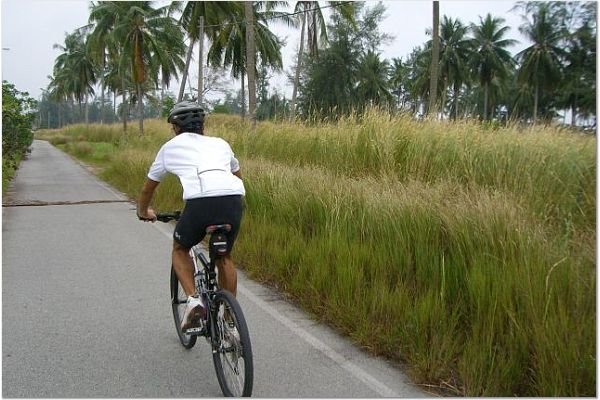
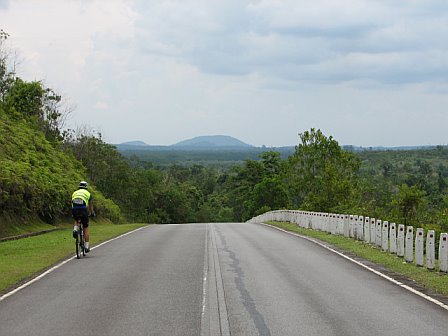
It's one of those rides where i wish time would come to a still, so that i can take forever to enjoy the beautiful scenery, soak in the atmosphere, enjoy the rare moment of being oblivious to all matters except the scenery that surrounds me. Photo courtesy of K.
Thursday, September 28, 2006
"The physical aspect of travel is, for me, the least interesting; what really draws me is the prospect of stepping out of the daylight of everything I know, into the shadows of what i don't know, and may never know. Confronted by the foreign, we grow newly attentive to the details of the world, even as we make out, sometimes, the larger outline that lies behind them."
Sun After Dark, by Pico Iyer
Tuesday, September 26, 2006
Riding to Unreality
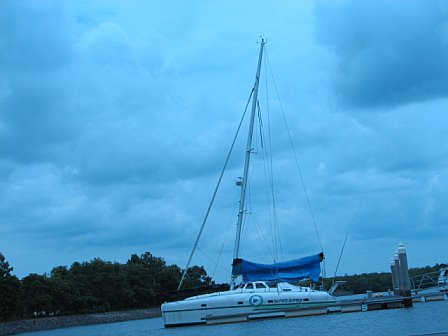
It is breezy; not only could one feel but hear it: the wind chime’s making soft, tinkling sounds, almost surreptitiously, as if it were afraid of intruding upon the silence of the place. From the verandah, the view is one of peaceful serenity. A river runs adjacent to the villa, its flow gentle and calm, beckoning one to leap into it (which I did the second day). Over at the other side of the river, an expanse of trees and grassland completes the picture of tranquility. When a motorbike and a van inconspicuously emerge from one end, one is somewhat surprised by the fact that a dirt track (or perhaps a paved road?) runs through the vast expanse of greenery. Distance provides concealment, but also gives a measure of comfort.
A concrete pillar fence, at waist-level height, separates the garden from the outside area. But it’s an inconsequential barrier. The exterior seems like a natural extension of the villa, merged seamlessly with the veranda and the cozy living hall, all three linked by an invisible passageway of open space, allowing unhindered wind movement. One hardly feels the confines of the garden, which is sparsely but simply adorned. At a corner there is a wooden rocking horse, quaintly charming; a large portrait, painted in melancholy blue hues, hangs on a wooden frame behind it; and next to it sits a sturdy wooden bench. Part of the lawn has been replaced by wooden planks, complementing the furniture and architecture of the villa. The ambience is snugly languorous, a much appreciated fact that doesn’t take long to register in the first-time visitor of the luxurious villa.
I stand on the verandah, letting the breeze caress my face as I admiringly take in the idyllic surroundings. Evening came, and Kenneth and I take a stroll along the pathway that runs alongside the river. There is no brilliant sunset, just a blue evening sky that is fast turning dark. As the river broadens and leads to the marina, two neat rows of stationary yachts and small boats come into view. Against the blue sky and with their reflections gleaming shakily in the water surface, it is a calm and beautiful sight to behold. Each time I find myself in such an environment, where nature abounds, I am filled with an inward peace and elation that is tinged with a certain sense of wistful yearning. Perhaps it is the realization that such moments are transient which evokes these paradoxical feelings, though the joy of being in that moment is never quite diminished. There’s a certain sense of unreality, of being disconnected from the world that you are more accustomed to than the one you now find yourself situated in. Being in a foreign place, with little else to do, I realize, can be a rehabilitative experience.
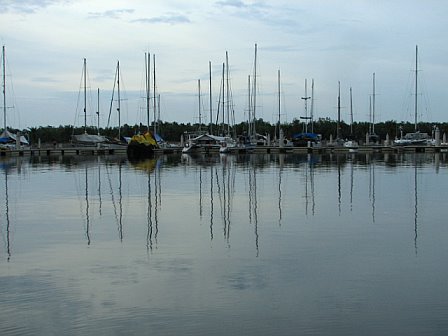
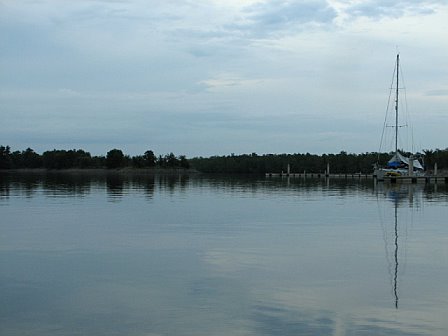

Early in the morning we had ridden across the causeway to Kota Tinggi, where we had roti prata for breakfast. I had done the same thing a week ago. This one, coming so soon after the last, incurred the displeasure of my Mum, who never liked the idea of my cycling on Malaysian roads. She ought to be comforted to know that Malaysian drivers are generally more friendly and respectful of cyclists as road users, and the roads in the Eastern side (which is where most cyclists ride) have fewer cars. But no, I don’t explain matters, because that will only invite more counter arguments that can’t be rationally retorted. It’s just the nature of all mums which makes one sometimes acquiesce to their demands, or sometimes keep quiet and let (their) ineffectual protests give way to grudging resignation.
I didn’t have any prior expectations of the ride, which I can’t decide whether it was a good or bad thing; for after breakfast, the terrain was hilly all the way to our destination. The gentle but long sloping roads had the three of us pedalling uphill slowly, and even more slowly after we glided down only to climb yet another sloping road. Because I did not know what to expect, I hadn’t any mental preparation but merely kept going, without any sense of dread or anticipation. We were very fortunate, though, that the weather was wonderfully cool for the most time, especially in the early morning; there were abundant clouds shielding us from direct sunlight, otherwise the ride would most certainly have been torturous, what with a killer combination of hilly terrain and blazing heat.
Cycling behind K, it’s amazing how he kept yawning with such rapid consistency, as though he’s a machine made to release explosive yawns every few minutes – yes, every few minutes, the whole morning! “I slept only 4 hours last night,” he would repeat this for the rest of the day, whenever he’s reminded of his incessant yawns. Along the way we met other cyclists, including a group of 30 cyclists who were spread far apart one another. Nearly all of them were from Singapore, and the latter group apparently was a cycling group from Punggol-Yishun. Some of them would most certainly qualify as senior citizens, and Kenneth, himself a veritable ‘Uncle’, called them ‘Senior Uncle’. I was so amused. I told him this is a comforting fact; it means when we are their age we can still cycle like they are now, and that is surely a reassuring prospect.
We were almost despairing when after cycling more than 120km the destination still seemed nowhere in sight. Our butt was aching, wrists hurting, back aching – just about every part of the body is in pain. When we saw the much-anticipated signboard, we were at once filled with hope; but hope soon gave way to helpless resignation as it was another 6km – Kenneth noted the distance at the end – after making a right turn before we finally reached the villa.
Post-ride was very good, not least because we stayed in a wonderful villa at a quiet location. I ate delicious lobsters at Sungei Ringett, had toasted bread with Ya-Kun kaya for breakfast and home-cooked pasta with yummy smoked sausages for lunch. I also watched Elektra, laughing together with the rest at its oh-so-amazing special effects, more hilarious than they are spectacular. Finally, of course, I also took a dip in the cool river and the pool, but not before canoeing with Kenneth down the river, to the marina, where we went between two parallel rows of yachts and boats.
Good things do happen every now and then, and when they do, it’s best to enjoy every moment while they last. I didn’t return to Singapore feeling reluctant to leave the place, because while I was there, I completely enjoyed myself, doing nothing, lounging on the sofa, enjoying the breeze and everything else. If only every post-ride could be similar to this…
Monday, September 18, 2006
N(o)73
The guys at Nokia certainly know how technology ticks and who their target market is. Well-known local bloggers Mr Brown, Mr Miyagi and Popagandhi have all been given a Nokia N73 which they have used and blogged positively about. No doubt because these bloggers reach out to a potentially large group of local consumers who are gadget-loving folks. This, surely, is a quick and effective way to market the delectable phone, given the credibility of those bloggers and their mass outreach to tech-savvy people - especially people like themselves who blog regularly and frequently upload photos to their blogs.
I must confess I am very tempted to own one myself. Not that I would readily upload my photos to Flickr straight from the phone if I do use it, but the 3.2megapixel in-built phone is proving very irresistable for folks like me who like to snap pictures anytime, anywhere and everywhere. And besides, the pictures taken on the N73 look very decent, seem to be of very good quality even - a requirement which i certainly insist when buying a camera, or a camera-phone.
Unfortunately, i can only dream about owning one at the moment, for its price is a little too costly for me to afford. To take pictures - good pictures - I would have to continue relying on my canon camera. I don't regret my choice of camera; i just wish to have another device that affords greater convenience.
I must confess I am very tempted to own one myself. Not that I would readily upload my photos to Flickr straight from the phone if I do use it, but the 3.2megapixel in-built phone is proving very irresistable for folks like me who like to snap pictures anytime, anywhere and everywhere. And besides, the pictures taken on the N73 look very decent, seem to be of very good quality even - a requirement which i certainly insist when buying a camera, or a camera-phone.
Unfortunately, i can only dream about owning one at the moment, for its price is a little too costly for me to afford. To take pictures - good pictures - I would have to continue relying on my canon camera. I don't regret my choice of camera; i just wish to have another device that affords greater convenience.
Friday, September 15, 2006
What book have you recently read
Of all the questions that came up during the interview, the one that took me by surprise – a little – was this: What book are you reading now?
It reminded me of an anecdote I heard in a resume writing workshop. The instructor told us that a female interviewee was once asked the same question, or something similar. The young lady hesitated for a while before giving this reply: "Her World."
Some in the room chuckled, no doubt amused by the seemingly embarrassing answer. For one thing, Her World is a magazine and not a book. Even if one were to overlook that fact, surely it doesn’t say much of someone who decides on the choice of a light-hearted female magazine in a corporate interview, does it?
I don’t know if that anecdote was fabricated or was it based on a real account. Whatever the case is, it is true that in some interviews people do ask about the books you read. I guess this could be as innocuous a question as, say, What are your hobbies? It’s just the kind of questions people would ask to find out more about someone’s likes and dislikes. By knowing what kind of books a person read, one is also able to, in an intuitive sense, get a feel of the quality of a person’s mind. Thus, reading a leaden economics-related book or an eighteenth century philosophical writing may point towards the direction of one’s intellectual inclinations.
But of course, so much about this is guess work. Many of us, I am sure, read very normal stuff like modern-day novels, travel writing or fantasy books (I don’t), among others. (Her World is also very normal stuff, except that it belongs to the sister category of books - magazines.) It is in my opinion perfectly fine to tell an interviewer what kind of book you are reading (if you are reading one at all), even if it’s some frivolous, unheard-of novels. The important thing is not the book, but how well you can intelligently engage the interviewer with your response. Say something about why you are reading the book (which my interviewer asked) and show that you’re interested in the subject. After all, I am sure not every person conducting interviews is fabulously well-read to know each and every available title. That should give you the confidence to speak freely and engagingly. Just don’t get carried away.
It reminded me of an anecdote I heard in a resume writing workshop. The instructor told us that a female interviewee was once asked the same question, or something similar. The young lady hesitated for a while before giving this reply: "Her World."
Some in the room chuckled, no doubt amused by the seemingly embarrassing answer. For one thing, Her World is a magazine and not a book. Even if one were to overlook that fact, surely it doesn’t say much of someone who decides on the choice of a light-hearted female magazine in a corporate interview, does it?
I don’t know if that anecdote was fabricated or was it based on a real account. Whatever the case is, it is true that in some interviews people do ask about the books you read. I guess this could be as innocuous a question as, say, What are your hobbies? It’s just the kind of questions people would ask to find out more about someone’s likes and dislikes. By knowing what kind of books a person read, one is also able to, in an intuitive sense, get a feel of the quality of a person’s mind. Thus, reading a leaden economics-related book or an eighteenth century philosophical writing may point towards the direction of one’s intellectual inclinations.
But of course, so much about this is guess work. Many of us, I am sure, read very normal stuff like modern-day novels, travel writing or fantasy books (I don’t), among others. (Her World is also very normal stuff, except that it belongs to the sister category of books - magazines.) It is in my opinion perfectly fine to tell an interviewer what kind of book you are reading (if you are reading one at all), even if it’s some frivolous, unheard-of novels. The important thing is not the book, but how well you can intelligently engage the interviewer with your response. Say something about why you are reading the book (which my interviewer asked) and show that you’re interested in the subject. After all, I am sure not every person conducting interviews is fabulously well-read to know each and every available title. That should give you the confidence to speak freely and engagingly. Just don’t get carried away.
Thursday, September 14, 2006
A soupy late afternoon
I've passed by The Soup Spoon at Raffles City many times and, always, it is having brisk business. I would look at the customers enviously, thinking in my mind how delicious their soup, served in respectably big-sized bowls, must be. All of them seem to be enjoying their meals anyway, oblivious to the curious glances of many a passer-by, who must have at a later time also decided to patronize the restaurant. And every customer, I noticed, seem to be having a glass of iced-lemon tea besides their soup dish. The iced tea must be damn good, I thought.
Well, I finally tasted the Soup experience myself on Tuesday where I was, at that fine moment when I made my orders and sat down, their only customer. It was four plus, that awkward period between afternoon tea and knock-off time, so the restaurants were relatively empty of customers. I had deliberated for a while before finally deciding to make a little splurge just to savour the experience of dining at The Soup Spoon. And I must say it was a good experience. I ordered meatless minestrone and upgraded it to a combo that comes with a half wrap and a choice of iced tea or salad (and something else which I can’t remember). Of course I had to order the iced tea (it was ok), though by then I had already realized why most of their customers always have an iced-tea in addition to the soup. The minestrone soup consists of a generous amount of ingredients (celery, potato, red date, etc) and was tasty, while the half wrap (cajun fish) was crispy and just as delightful.
Such an off-peak period like this is just the perfect moment to enjoy soup and tea over a chat with friends. It’s not noisy as there are few people around, and the easy-going music that is being played provides the right mix of ambience under the soft lighting. Unfortunately, precisely because it is an off-peak period, there are few people in the city area who can afford the time to lounge at restaurants. Two men who seated themselves at a table away from me were business executives having a discussion, and it was not until nearly 45 minutes later, when their meeting presumably had ended, that they ordered food. Further away, a couple in JC uniform were having dinner.
As for me, I spent the late afternoon like a freewheeling bourgeoisie when in fact I’m a disguised proletariat who isn’t even contributing to the capitalist economy, damned! It was pleasurable though (isn’t a bourgeoisie’s life so?), for I indulged in my novel in between sipping mouthfuls of minestrone soup. Occasionally I would be distracted by the movement of people around the area. Nevertheless, it was a very peaceful and, I daresay, enviable afternoon reading a good novel in a crowd-free restaurant that serves light, delectable fare.
Yummyful!
Well, I finally tasted the Soup experience myself on Tuesday where I was, at that fine moment when I made my orders and sat down, their only customer. It was four plus, that awkward period between afternoon tea and knock-off time, so the restaurants were relatively empty of customers. I had deliberated for a while before finally deciding to make a little splurge just to savour the experience of dining at The Soup Spoon. And I must say it was a good experience. I ordered meatless minestrone and upgraded it to a combo that comes with a half wrap and a choice of iced tea or salad (and something else which I can’t remember). Of course I had to order the iced tea (it was ok), though by then I had already realized why most of their customers always have an iced-tea in addition to the soup. The minestrone soup consists of a generous amount of ingredients (celery, potato, red date, etc) and was tasty, while the half wrap (cajun fish) was crispy and just as delightful.
Such an off-peak period like this is just the perfect moment to enjoy soup and tea over a chat with friends. It’s not noisy as there are few people around, and the easy-going music that is being played provides the right mix of ambience under the soft lighting. Unfortunately, precisely because it is an off-peak period, there are few people in the city area who can afford the time to lounge at restaurants. Two men who seated themselves at a table away from me were business executives having a discussion, and it was not until nearly 45 minutes later, when their meeting presumably had ended, that they ordered food. Further away, a couple in JC uniform were having dinner.
As for me, I spent the late afternoon like a freewheeling bourgeoisie when in fact I’m a disguised proletariat who isn’t even contributing to the capitalist economy, damned! It was pleasurable though (isn’t a bourgeoisie’s life so?), for I indulged in my novel in between sipping mouthfuls of minestrone soup. Occasionally I would be distracted by the movement of people around the area. Nevertheless, it was a very peaceful and, I daresay, enviable afternoon reading a good novel in a crowd-free restaurant that serves light, delectable fare.
Yummyful!
Tuesday, September 12, 2006
To Kota Tinggi
We were talking about it on Thursday night at Holland V. Coffee Club - and well, it did materialise on Saturday, though there was a slight change in plans. Instead of cycling in Singapore (yawn), we met at 630am, cycled across the causeway and up to Kota Tinggi. Cycling across to Malaysia is probably something very common for many cyclists here, but for me, it was only my second time cycling across the causeway (though not in Malaysia). It feels very different (duh), as though one could feel every sense of movement whilst pedalling the bike on that narrow stretch of road that separates Singapore from its northern neighbour. I don't get that feeling when i take the bus to Johore, which is what i usually do when travelling to Malaysia. Most often, it's a tiring business going by bus: you have to alight at the Singapore custom checkpoint and then board the bus again, then alight again at the Malaysian side - and going through all this whilst squeezing with families, workers and hordes of other people eager to beat others at the immigration queue.
Going by bike entails a lot less hassle. After going up a steep slope, we turned to the extreme left where the signboard indicates the lane for motorbikes. We were the only cyclists around, and we dutifully joined the motorists in front of us. The queue was slow moving on my side as it was served by only one counter. Whilst queuing, i noticed that the cars heading towards Malaysia were mostly Singapore-licensed plates. Are these Singaporeans going for a weekend getaway, to play golf, or visit their relatives? No doubt they were early because they wished to avoid the nasty traffic jam.
Finally, when we were done clearing the Malaysian customs, our passports kept, we rode to the main road where fast-passing cars made me feel uneasy. There was no problem finding our way as it is a very straightforward route from Johore Bahru to Kota Tinggi. There were big, prominent signboards that show the way and besides, both K and Jon had cycled to Kota Tinggi before. In less than 2 hours we reached Kota Tinggi. We had a pleasant breakfast that consisted of mee rebus and roti prata. Needless to say, we paid what would have cost us twice the amount in Singapore.
It was a good ride overall. Jon and K both make for great cycling company; we always have interesting conversations and laugh-out-loud jokes, not least because Jon always spouts crassly hilarious lines. The only gripe we have was the bumpy road and air pollution in Johore. At the end of the ride, we were covered by a visible layer of grime and dirt!
Subscribe to:
Posts (Atom)